
Scratch RecSys 02 - Production-Grade Reference Architecture for ZaPudia
Creating the architecture and tell why need to be that.
1. Introduction
Think of building a recommendation system like constructing your dream home. If you try to build a futuristic, ultra-fancy smart mansion all at once on day one, installing automated robot waiters, custom glass ceilings, and voice-controlled everything before you’ve even laid down a solid floor, you’re setting yourself up for a total disaster. The moment a light bulb flickers, you won’t even know which wire went wrong in that massive mess, and the whole house might just come crashing down.
That’s exactly why you shouldn’t launch a super complicated, high-tech AI recommendation system right out of the gate. If you try to throw every advanced algorithm at your users all at once, it becomes a huge headache to manage. If something breaks, finding the bug is like looking for a needle in a haystack, and your users end up with a glitchy experience. Instead, the smart move is to build it step by step. First, build a simple, sturdy wooden cabin that keeps the rain out. Once that’s working great and adding real value, you add basic electricity, then cozy furniture, and finally, all the cool smart-home gadgets.
By rolling out your system in small, easy stages, you keep things safe and stress-free. Your business gets quick wins right away, and you get to build a rock-solid foundation for smarter features down the road, without pulling your hair out when something goes wrong!
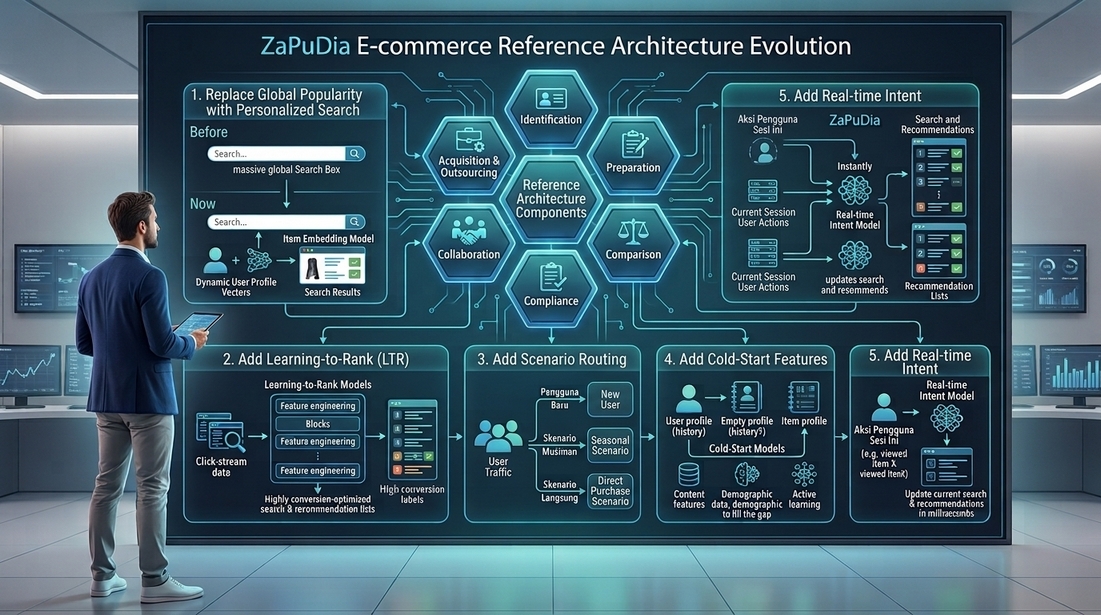
Stage 1: Transitioning to Personalized Retrieval
The primary objective of Stage 1 is to replace non-personalized baseline logic with personalized candidate retrieval:
Instead of serving static top-charts, the system deploys a collaborative filtering model (e.g., Alternating Least Squares) served via a lightweight FastAPI backend. To maintain low latency, user and item representations are cached in a Redis feature store. The pipeline is safeguarded with business-rule filtering (e.g., inventory and locality checks) and a global popularity fallback for zero-result scenarios.
Success at this stage is evaluated across both behavioral and infrastructure metrics:
- Recommendation Quality: Recall@100, Click-Through Rate (CTR), and Conversion Rate (CVR).
- System Performance: P99 latency SLAs.
Stage 2: Implementing Learning-to-Rank (LTR)
Once personalized candidate generation is stable, Stage 2 decouples candidate retrieval from scoring by introducing a dedicated Learning-to-Rank (LTR) model:
In this two-stage architecture, the retrieval layer rapidly filters millions of catalog items down to a dynamic candidate pool of 500 to 2,000 items. A gradient-boosted decision tree model (e.g., LightGBM) then ranks these candidates using rich pointwise and pairwise features to yield the final Top-20 recommendations.
Separating fast, broad retrieval from high-precision ranking represents the highest-return architectural investment in recommendation engineering.
Stage 3: Context-Aware Scenario Routing
A single global scoring model rarely performs optimally across all user touchpoints. Stage 3 transforms the system from a “one-model-fits-all” solution into a context-aware recommender that dynamically adjusts candidate selection and business rules based on the user’s current surface (e.g., Home Feed, Post-Purchase Cross-Sell, or Search Fallback).
Stage 4: Mitigating Cold-Start with Content & Context
Pure collaborative filtering suffers from the cold-start problem when dealing with new users or newly onboarded SKUs with sparse interaction histories. Stage 4 introduces a hybrid feature layer:
By incorporating content signals (e.g., item embeddings, descriptions, category hierarchies), user demographics, contextual state, and empirical popularity priors, the system accurately scores new items and users from their very first interaction. This breaks the self-reinforcing popularity feedback loop and protects new sellers and products from being overlooked.
Stage 5: Capturing Real-Time Session Intent
While historical interactions reflect long-term user preferences, immediate session behavior reveals current intent. Stage 5 introduces high-throughput real-time streaming infrastructure:
The recommendation engine dynamically combines long-term historical affinity with real-time session signals:
The balancing weight is dynamically controlled by the volume and intensity of real-time session evidence ():
Where is a scaling factor.
As real-time session activity () increases, the value of automatically decreases toward zero. As a result, the influence of historical profile diminishes, allowing short-term intent to dominate current ranking decisions.
2. Production Guardrails
Think of an un-guardrailed recommendation engine as a hyper-eager rookie salesperson. Left to its own devices, it will happily push out-of-stock items, promote products from shady sellers to maximize short-term clicks, or spam customers with 20 slightly different black t-shirts. Guardrails are the ground rules that keep your AI helpful, reliable, and sane. Here is how to lock down your recommendation system in production:
1. Inventory Eligibility (The “Don’t Sell Ghosts” Rule)
Recommending an out-of-stock item is like a waiter describing a mouth-watering steak, taking your order, and then coming back 10 minutes later to say, “Oops, the kitchen is actually out.” Unless your store explicitly supports backorders, enforce a strict check: if , strip the item from recommendations immediately.
2. Seller Quality (The “Shady Vendor” Filter)
An algorithm might notice that a cheap gadget gets massive click-through rates, but if that third-party seller takes three weeks to ship or has a 40% return rate, recommending it destroys customer trust in your entire platform. Automatically filter out or heavily penalize products linked to poor fulfillment, high returns, or policy violations, no matter how high their engagement score is.
3. Category Constraints (The “Don’t Be Boring” Rule)
If a customer clicks on a pair of white sneakers, a naive algorithm will usually try to show them 20 nearly identical white sneakers. That isn’t a recommendation list; it’s a wall of duplicates. Enforce list diversity. Limit how many items from the exact same sub-category, brand, or SKU cluster can appear in a single recommendation feed so users get actual choices.
4. Exposure Concentration (The “Radio Hits” Problem)
Without guardrails, recommendation algorithms tend to create a popular-gets-richer feedback loop, like a radio station playing the same top 40 songs until everyone turns off the radio. Track Catalog Coverage (the percentage of your total inventory actually getting shown) and the Gini Coefficient (how unevenly exposure is distributed). Monitor these to ensure the algorithm isn’t ignoring 95% of your catalog just to play it safe with a few bestsellers.
5. Model Rollbacks (The “Emergency Brake”)
Deploying a new model (homepage-ltr-v13) that accidentally tanks conversion rates shouldn’t turn into a midnight engineering crisis. Keep every online model strictly versioned (e.g., homepage-ltr-v12, pdp-fbt-v8). If a newly deployed model acts up in production, you must be able to flip a toggle and roll back to the previous stable version instantly, without taking down or re-architecting the rest of your serving pipeline.
3. Observability Requirements
Running a recommendation system in production without multi-tiered observability is like driving a race car with only a speedometer. You might see that you are moving fast, but you won’t notice that your tires are flat or that you’re driving in the wrong direction. To keep a recommender healthy, reliable, and profitable, you need to monitor three distinct operational layers simultaneously.
1. Model Observability (The Navigation)
This tells you if your AI is still making smart predictions. Offline validation metrics quickly go stale once real users interact with your application. You need live tracking for ranking accuracy, such as Recall@K, NDCG@K, and MAP@K, to verify candidate relevance. Equally critical is monitoring drift: feature drift (user behavior changing), embedding drift (vector spaces shifting), and overall model drift. When drift strikes, your once-brilliant model effectively starts throwing random darts.
2. System Observability (The Engine)
Even the smartest ranker is useless if it takes two seconds to respond. This is your classic low-latency infrastructure telemetry, tailored for real-time ML pipelines. Track P50, P95, and especially P99 latency to catch tail latency spikes before they degrade user experience. Monitor CPU/memory saturation, cache hit ratios, QPS, error rates, and timeout counts. If your inference service times out, the client falls back to static popularity lists, rendering your complex ML pipeline completely pointless.
3. Business Observability (The Bottom Line)
A model can yield mathematically elegant predictions, but if users aren’t buying, the platform bleeds out. Track immediate user engagement through Click-Through Rate (CTR) and Conversion Rate (CVR), alongside revenue indicators like Average Order Value (AOV) and Gross Merchandise Value (GMV). Watch long-term ecosystem health: D30 retention, cross-sell velocity, Catalog Coverage (are 95% of your products rotting in obscurity?), and seller exposure distribution to prevent merchant churn.
4. The Unified Triad Rule
The core principle of recommender telemetry is linking all three layers onto a single glass pane:
Never view these metrics in isolation. A model can boast an outstanding NDCG score while the gRPC service silently hits timeouts and drops half its traffic. Conversely, your FastAPI cluster can deliver a blazingly fast 5ms P99 latency while serving nonsensical items that collapse GMV. Both are severe outages, they just wear different masks.
4. Reference End-to-End Data Flow
Think of an end-to-end recommendation pipeline like a high-end restaurant kitchen. You would never butcher a cow or simmer a 24-hour broth while the customer is sitting at table three waiting for dinner. You prep ingredients in the background so the line cook can plate a world-class dish in under three minutes. Separating offline training from online inference is what keeps your system fast, stable, and scalable under heavy traffic.
The Background Prep (Offline Training)
The offline pipeline works like overnight prep cooks. It processes heavy batch data, learns complex user behaviors, and updates model weights without blocking real-time user requests:
The Live Order (Online Inference)
When a user hits your homepage, the online engine executes a lightning-fast assembly line in sub-100ms real time:
Connecting these two worlds requires a seamless handoff: real-time user telemetry travels through streaming infrastructure (Kafka), writes live features into low-latency stores (Redis), combines with batch embeddings from training storage, and feeds directly into real-time rankers.
5. Final Architectural Decision
Building a recommendation engine presents two classic traps:
- The Monolith Trap: Trying to throw every item in your catalog into one gigantic end-to-end deep neural network. It’s accurate in theory, but it will melt your infrastructure budget and break your 100ms latency SLA.
- The Lazy Shortcut: Falling back on global popularity lists. It’s blazingly fast, but it completely ignores personalization and feels spammy to users.
The optimal solution is a Multi-Stage, Hybrid, Scenario-Aware System. Think of it like casting actors for a blockbuster movie: you don’t give a 2-hour deep audition to 100,000 applicants. You hold a broad casting call to pick 500 decent candidates, run an intensive screen test on those 500 to rank the top 10, and let HR run background checks before handing out the contract.
Mathematical Foundations: A Division of Labor
Rather than relying on one algorithm to solve everything, distribute your mathematical objectives across specialized layers:
- iALS (Implicit Alternating Least Squares): Optimizes latent preference reconstruction across matrix factorization spaces:
- BPR (Bayesian Personalized Ranking): Optimizes relative pairwise orderings so the model learns that a user prefers item over item :
- Two-Tower Deep Learning: Scales high-dimensional vector representations by mapping user and item features into a shared embedding space for instant Approximate Nearest Neighbor (ANN) lookup:
- LightGBM LTR (Learning to Rank): Takes the retrieved candidates and applies gradient-boosted decision trees over cross-features to optimize strict list ordering.
System Architecture Responsibilities
- Retrieval = Maximizing Recall: Casts a wide net to reduce millions of inventory items down to a few hundred plausible candidates.
- Ranking = Maximizing Precision: Uses rich features to meticulously score and sort those few hundred candidates.
- Business Layer = Enforcing Constraints: Applies real-world business logic (removing out-of-stock items, enforcing brand diversity, applying seller quality filters).
- Serving Layer = Guaranteeing Low Latency: Serves the final payload quickly and reliably under peak traffic loads.
- Experimentation = Causal Validation: Uses A/B testing framework hooks to verify that new model iterations actually drive incremental revenue rather than random metric noise.
6. Engineering North Star
Let’s be honest: training a Machine Learning model in a Jupyter notebook with 95% accuracy is the easy part. Building an enterprise recommendation system in production is a completely different ballgame. It isn’t just a prediction problem, it is a multi-objective optimization challenge operating under brutal real-time constraints.
Our ultimate system objective can be expressed mathematically as:
What does this actually mean?
Think of our system like driving a Formula 1 race car.
Winning the race isn’t just about slamming the gas pedal for immediate speed (clicks or CTR, and conversions or CVR). If all you optimize for is CTR, your model turns into a clickbait machine, showing cheap $1 gadgets that get clicked today, but ruin long-term trust.
To maximize true Business Value, the engine must balance:
- Immediate conversion: Clicks (CTR), Buys (CVR), and Cart Value (AOV).
- Long-term growth: User Retention and category discovery (CrossSell).
- Ecosystem vitality: CatalogHealth, making sure new or niche sellers actually get discovered instead of drowning under big brands.
The Operational Boundaries
However, raw business optimization means nothing if the system breaks in production. Our race car has to operate inside strict engineering guardrails:
Here is how these four guardrails keep the engine from blowing up:
- Strict Sub-100ms Latency (): If our car takes three seconds to react at a hairpin turn, it crashes. If our recommender takes 500ms to load, users abandon the app. 99% of all API calls must return a fully ranked feed in under 100 milliseconds.
- Cost Control (): You can’t spend 5,000 in revenue. Efficiency matters.
- High Availability (): Zero downtime. If the recommendation service drops, the storefront must degrade gracefully without crashing the whole mobile app.
- Anti-Monopoly Protection (): Prevents the “rich-get-richer” bias. If the algorithm only recommends the top 10 most viral SKUs, 99.9% of your catalog rots unnoticed.
The recommendation engine succeeds only when all four dimensions are simultaneously satisfied.
Shift Your Mindset: A Closed-Loop Decision Infrastructure
The system is therefore not merely an ML model sitting behind an endpoint. It is a decision infrastructure.
The Michelin-Star Chef Analogy
Imagine a head chef running a high-end restaurant:
- Raw Behavior: The chef notes what dishes guests clean off their plates and what drinks they send back.
- Preference Representation: Translating those actions into latent tastes (“This table loves spicy food but avoids dairy”).
- Candidate Set: Instantly narrowing down a massive pantry of 1,000,000 raw ingredients to a shortlist of 50 relevant items.
- Ranked Decision: Plating the exact 5-course menu sequence optimized for taste, speed, and margin.
- Business Outcome & Feedback: Observing if the guest leaves a 5-star review, then adjusting tomorrow’s recipe based on the outcome.
The engine constantly makes decisions, observes the user’s reaction, and learns from the consequences in a continuous feedback loop.
The Architectural Frame for ZaPudia
To put this into concrete technical terms for ZaPudia:
Use
cooprecsysand collaborative retrieval to generate a high-recall candidate pool, use specialized models for scenario-specific relevance, use LightGBM LTR to perform low-latency re-ranking, and use explicit business and marketplace guardrails to prevent the recommender from optimizing engagement at the expense of long-term ecosystem health.
Think of this as a 4-Stage Recommendation Funnel:
- Cast a Wide Net (Candidate Retrieval): Use
cooprecsys( matrix factorization) and vector search to instantly prune 1,000,000+ catalog items down to ~500 candidate SKUs in milliseconds. - Context Adaptation: Apply scenario-aware filters depending on where the user is (Homepage discovery vs. Product Detail Page upselling).
- Precision Sorting (LightGBM LTR): Use heavy GBDT Learning-to-Rank models on those ~500 candidates, scoring them with rich user signals, realtime features, and contextual interactions.
- The Gatekeeper (Business Guardrails): Run post-ranking rules to drop out-of-stock SKUs, cap repeated sellers, and inject catalog diversity before returning the payload to the frontend.
The Executable ML Pipeline
Part 1 establishes the mathematical and architectural foundation.
The next engineering step is to convert these definitions into a fully automated, executable software factory:
The Automated Car Assembly Line
Think of this pipeline as an automated Tesla factory line:
- Clickstream Events enter through strict data Schemas (no corrupted payload gets through).
- Raw logs are transformed into real-time Features inside a Feature Store (Redis/DuckDB).
- Feature snapshots are combined into deterministic Training Sets.
- Models (LightGBM/iALS) train and undergo automated offline Evaluation.
- Validated models are deployed to high-throughput Serving infrastructure (FastAPI).
- Traffic is split via A/B Testing to measure real business lift against baseline.
- Production logs trigger Continuous Retraining loops automatically.
Every single contract and interface in this pipeline is versioned, reproducible, and treated like production code.
7. Bridge to Part 3: From Blueprint to Production Code
In Part 2, we drew up the architectural blueprints for ZaPudia’s recommendation infrastructure. We mapped out our multi-stage funnel, established our mathematical loss functions, defined non-negotiable business guardrails, and built a unified telemetry triad. Think of Part 2 as the civil engineering phase: we surveyed the terrain, calculated structural loads, and approved the master schematics. Now comes the actual construction work, laying steel, pouring concrete, and wiring the high-voltage electrical grid.
Theory is cheap, production code is what actually ships value. In Part 3: End-to-End cooprecsys Implementation, we will turn these theoretical concepts into battle-tested Python, DuckDB, and C++ extensions. We are going to build the core recommendation engine from scratch, step by step:
- Implicit Matrix Construction: Transforming raw clickstream events into compressed sparse row (CSR) matrices using implicit confidence weighting ().
- iALS Engine with Diagonal-Gram Optimization: Accelerating matrix factorization by precomputing the global Gram matrix to bypass redundant matrix inversions.
- Two-Tower Neural Retrieval: Training dual embedding networks with sampling correction to eliminate popularity bias from candidate generation.
- LightGBM LTR Feature Factory: Engineering dense pointwise, pairwise, and contextual cross-features for high-precision GBDT re-ranking.
- FastAPI Serving & Latency Watchdog: Building an asynchronous serving layer equipped with dynamic timeouts to enforce our latency budget under real traffic.
Grab your coffee, fire up your terminal, and let’s build cooprecsys line by line.